Some mechanical watches fascinate because you can hear them tick. Then there’s Spring Drive, which fascinates precisely because you can’t. Its seconds hand sweeps across the dial with an almost unnaturally smooth motion, yet the energy driving it comes from a conventional mainspring.
That combination is what has made Grand Seiko Spring Drive one of the most distinctive innovations in modern watchmaking.
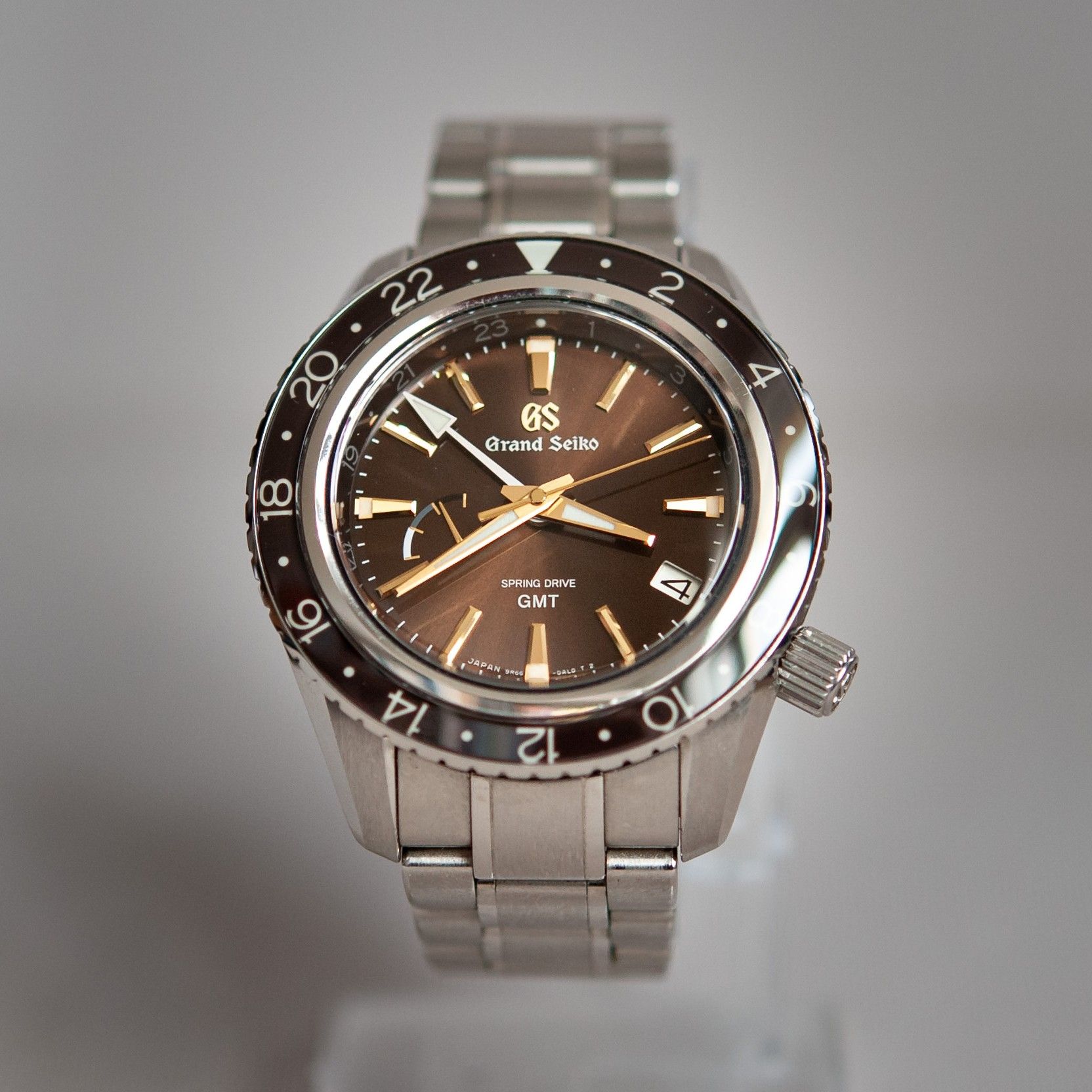
An Idea That Took More Than 20 Years to Become Reality
The story began in 1977 with Seiko engineer Yoshikazu Akahane. He had an ambitious idea: to create a watch powered by a mechanical mainspring but capable of the accuracy of an electronic timepiece.
It sounds simple in hindsight. It wasn’t.
Spring Drive required mechanical movement technology and electronics to function as a single system. Among other challenges, Seiko’s engineers had to find a way to generate enough electrical energy from the unwinding mainspring to power a quartz crystal and the associated electronics. According to Grand Seiko’s own history, more than 600 prototypes were produced during the development process.
The technology was unveiled at Baselworld in 1998. The first Spring Drive watch subsequently reached the market in 1999 as a limited-edition Seiko model with manual winding, while Spring Drive became an exclusive Grand Seiko technology in 2004 with the introduction of the automatic 9R65 calibre.
That last point matters. Spring Drive wasn’t originally born as a Grand Seiko technology. It was Grand Seiko that later turned it into a defining part of its modern identity.
Mechanical, Quartz – or Something Entirely Different?
This is where Spring Drive becomes particularly interesting for collectors.
A traditional mechanical watch stores energy in a mainspring. That energy passes through the gear train and is regulated by a balance wheel and conventional escapement.
A quartz watch works in an entirely different way. A battery supplies electrical energy to a quartz crystal, whose highly stable oscillations are used to regulate the passage of time.
Spring Drive starts out like a mechanical watch.
The mainspring is its sole source of power. There is no battery driving the movement. The mainspring powers the gear train and seconds hand while also driving a small generator that produces electricity. That electrical energy powers a quartz crystal and the electronics responsible for regulation.
The result is a fascinating architecture:
Mechanical power source → electrical energy → quartz crystal → electromagnetic regulation → mechanical movement of the hands.
That’s why trying to force Spring Drive into either the “mechanical” or “quartz” category doesn’t really work.
It is mechanical in the way it gets its energy, but electronically regulated.
And that is precisely why it occupies a category of its own.
The Tri-Synchro Regulator Is the Brain of the System
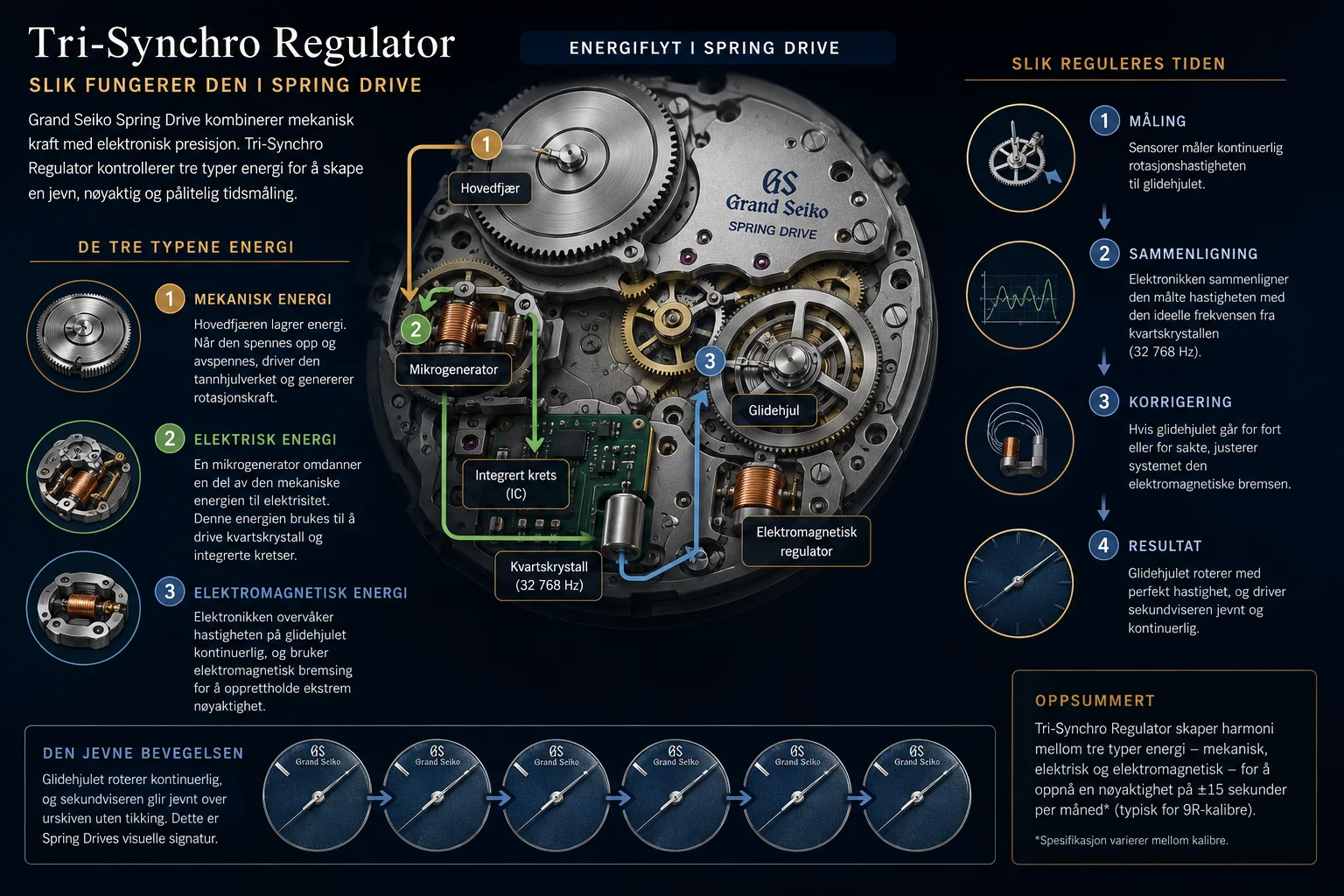
The name sounds almost unnecessarily complicated, but the principle is elegant.
The Tri-Synchro Regulator coordinates three forms of energy:
1. Mechanical Energy
The mainspring stores the energy. As it unwinds, it drives the movement’s gear train.
2. Electrical Energy
A small generator converts part of that mechanical energy into electricity. This energy powers the quartz crystal and integrated circuits.
3. Electromagnetic Energy
The electronics continuously monitor the speed of the glide wheel and regulate it using an electromagnetic brake.
The clever part is that the system doesn’t need a separate motor to move the hands. The mainspring is still doing the work. The electronics simply determine how quickly that energy is released through the system.
That is quite different from how many people instinctively imagine a “hybrid watch” to work.
Why the Seconds Hand Moves So Differently
Look at the seconds hand on a Spring Drive.
It doesn’t tick.
It doesn’t jump from second to second like a conventional quartz watch.
It glides.
The reason is that the glide wheel rotates continuously, while the Tri-Synchro Regulator controls its speed through electromagnetic braking. The result is an almost continuous motion that has become one of Spring Drive’s defining visual characteristics.
It’s a small detail, but visually it makes a remarkable difference.
On a good mechanical watch, you can see time advancing in small increments. With Spring Drive, you get the impression that time itself is flowing across the dial.
It also fits naturally with Grand Seiko’s Japanese aesthetic, where serenity, precision and the movements of nature often play an important role.
The Accuracy Explains Why the Technology Matters
A traditional mechanical watch constantly has to contend with physical variables. Temperature, position, friction and other factors all influence regulation.
Spring Drive instead uses the stability of a quartz crystal as its reference.
Many of Grand Seiko’s classic 9R calibres are rated to an accuracy of ±15 seconds per month, equivalent to roughly ±1 second per day.
That is an entirely different level of performance from what you would normally expect from a mechanical movement.
And the technology has continued to evolve. Today’s Spring Drive family includes the five-day 9RA2 and 9RA5 calibres, while 2025 saw the introduction of Spring Drive U.F.A. with calibre 9RB2, rated to an impressive ±20 seconds per year.
That makes the history even more interesting: Spring Drive wasn’t a finished concept in 1998. It was the beginning of an entirely new branch of watchmaking.
Grand Seiko Turned Spring Drive Into More Than Technology
Grand Seiko has always approached luxury watchmaking somewhat differently.
While some Swiss manufacturers place a strong emphasis on tradition and historical continuity, Grand Seiko has been more willing to combine tradition with a determination to develop its own technical solutions.
Spring Drive fits that philosophy perfectly.
Grand Seiko has three principal movement families:
– 9S – mechanical movements
– 9F – quartz
– 9R – Spring Drive
The important point is that Spring Drive isn’t intended as a compromise between the other two. Grand Seiko presents it as a technology in its own right, combining a mechanical power source with electronic regulation.
That is also why Spring Drive has earned such a strong following among enthusiasts who are otherwise deeply committed to traditional mechanical watchmaking.
The Snowflake Shows Why the Technology Isn’t the Whole Story
Grand Seiko Snowflake may be the best-known example.
The SBGA211 – the modern model that carries the Snowflake concept forward – combines Spring Drive with a dial inspired by the snow-covered landscape of the Shinshu region. Its distinctive texture isn’t simply decoration. It forms part of Grand Seiko’s way of connecting the watch with the landscape and the place where its watches are made.
It’s a good example of the difference between technical innovation and the watch as an object.
Spring Drive explains how the watch works.
Snowflake explains why you want to own it.
That combination is what makes Grand Seiko so interesting.
Materials Are Part of the Philosophy
Grand Seiko has also invested heavily in materials and finishing.
High-Intensity Titanium keeps the watch light while offering high resistance to corrosion and wear.
Ever-Brilliant Steel is a proprietary stainless steel developed to provide exceptional corrosion resistance and a distinctive bright finish.
But the materials are only part of the story.
What often catches the attention of experienced collectors is the way Grand Seiko works with polished and brushed surfaces, sharp edges and exceptionally precise transitions between different finishes.
This is where Spring Drive’s technological sophistication meets the more traditional side of Japanese watchmaking.
The Pre-Owned Market Makes Spring Drive Even More Interesting
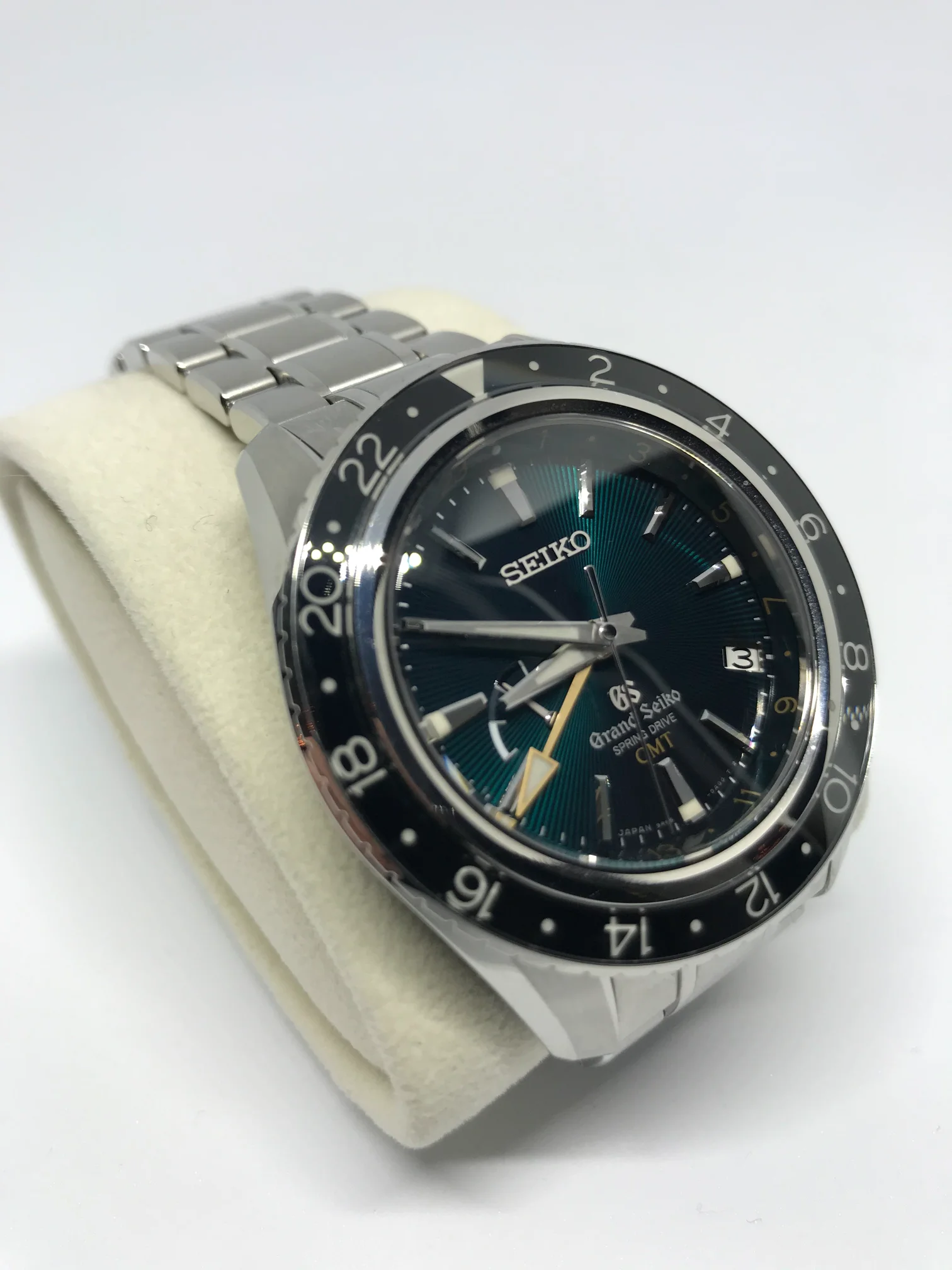
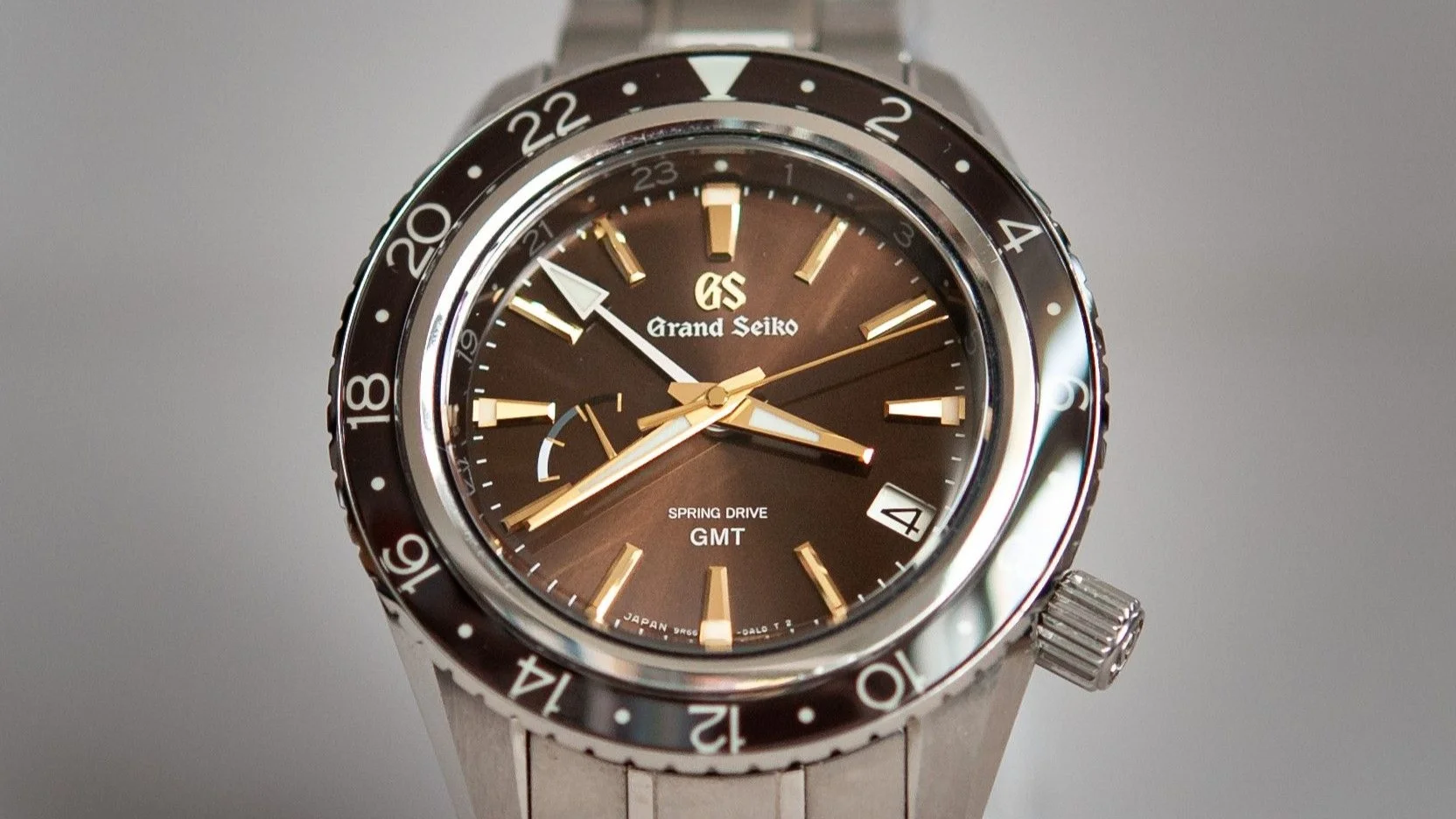
Grand Seiko Spring Drive GMT Limited Edition SBGE021
One of the most appealing aspects of Spring Drive is the pre-owned market.
A new Grand Seiko can represent a substantial investment. On the secondary market, the picture can be quite different.
Earlier and discontinued models can give collectors access to movements and designs that are no longer part of the current collection. For some collectors, that can be more interesting than simply buying the latest model.
The Snowflake is a good example. The earlier SBGA011 has earned a strong following among Grand Seiko enthusiasts, while its successor, the SBGA211, continues much of the same design language.
That said, it’s important to distinguish between list price, actual market price and what a particular watch can realistically sell for. Pre-owned prices vary considerably depending on age, condition, completeness, service history and geographic market.
For a collector, an older Spring Drive can therefore be more interesting than the latest model.
Not necessarily because it is technically better.
But because it tells part of the story.
The Real Question Isn’t “Mechanical or Quartz?”
For the traditional mechanical-watch enthusiast, Spring Drive can feel slightly problematic.
There is no conventional oscillating balance spring. No traditional escapement. And no battery-powered quartz movement either.
But perhaps that is simply the wrong question to ask.
If you believe a mechanical watch must be regulated entirely through mechanical means, then Spring Drive isn’t a mechanical watch.
If you define the watch by its power source, however, Spring Drive has much in common with mechanical watches: the mainspring is the source of power, and there is no battery driving the movement.
And when you consider the system as a whole, calling it pure quartz is equally difficult.
It makes more sense to regard Spring Drive as a new type of movement that takes the best of two technological traditions.
That was precisely the idea Akahane set out to achieve.
Is Spring Drive Actually Better Than a Mechanical Movement?
That depends on what you value.
If accuracy is the priority, Spring Drive has an obvious advantage.
If you love traditional mechanics, a fine 9S movement may be more fascinating.
If you value technological originality, Spring Drive is difficult to beat.
And if you appreciate details that only reveal themselves through regular wear, the smooth movement of the seconds hand is a small but remarkably satisfying argument in its favour.
There is another quality, too: Spring Drive doesn’t feel like an electronic watch.
It feels like a mechanical watch.
You wind the mainspring. You can see the gears at work. You experience the watch as a mechanical object.
Yet its regulation works in a way traditional mechanical watches simply cannot match.
That contrast is exactly what makes the technology so compelling.
25 Years Later, the Idea Is Still Radical
Spring Drive began as an idea in the late 1970s. It was publicly demonstrated in 1998, entered production in 1999 and became part of Grand Seiko’s core identity in 2004.
That is an unusually long development story.
And perhaps that is the most important part of it.
Spring Drive wasn’t created because the market was demanding a “hybrid watch.” It was developed because a group of engineers believed there had to be a better way to combine mechanical energy with electronic precision.
The result wasn’t a compromise.
It was a new category.
If You’re Considering a Grand Seiko Spring Drive
Focus first on the calibre, service history, condition and the generation you actually like – not simply the model number on the dial.
An older Spring Drive can be a particularly interesting purchase if you want to own something with a distinct place in modern watch history. And if you’re still unsure whether Spring Drive “counts” as a mechanical watch, perhaps that is precisely what makes it worth exploring.
Look at the seconds hand. Watch the way it moves. Then look at the movement. It’s hard to find a better introduction to what Spring Drive is really about.